The BSc Agriculture Syllabus is structured around crop production, soil science, horticulture, genetics and plant breeding, plant protection, agricultural economics, farm management and allied agricultural sciences. The programme is generally four years long and combines classroom teaching with laboratory work, field exercises, experiential learning and industry or rural exposure. The exact subjects and their semester-wise distribution can differ between universities because institutions implement their approved curricula under the broader agricultural education framework.
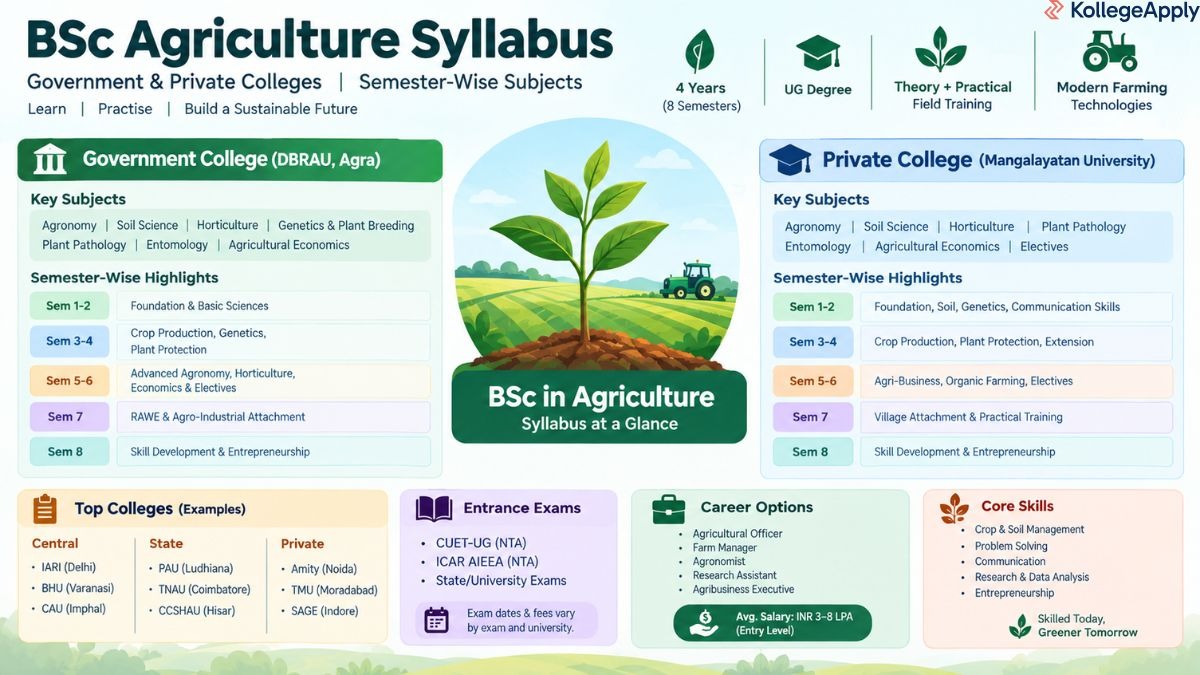
The Government College BSc Agriculture Syllabus and Private College BSc Agriculture Syllabus therefore have substantial overlap in core agricultural subjects, but they should not be treated as identical. For example, the DBRAU syllabus includes subjects such as Agronomy, Soil Science, Genetics, Horticulture, Entomology, Plant Pathology, Agricultural Economics and Crop Production, while Mangalayatan University's official curriculum includes similar core areas with its own elective and practical-course structure.
- Government College BSc Agriculture Syllabus
- Elective Subjects in BSc Agriculture Syllabus
- Private College BSc Agriculture Syllabus
- Electives in BSc Agriculture Syllabus
- Practical Training and Internship in BSc Agriculture
- Skills Developed Through BSc Agriculture Syllabus
- Books for BSc Agriculture Syllabus
- BSc Agriculture Syllabus FAQs
Government College BSc Agriculture Syllabus
The semester-wise BSc Agriculture syllabus below follows the Dr Bhimrao Ambedkar University (DBRAU), Agra curriculum supplied for this article. DBRAU's Department of Agriculture lists B.Sc. (Hons.) Agriculture as a four-year programme and identifies the university syllabus as the curriculum for the course.
Each semester progressively builds technical skills through field training, lab work, and the Rural Agricultural Work Experience (RAWE) program, preparing students for careers in modern agriculture, research, and agribusiness. The following is the Dr Bhimrao Ambedkar University (originally known as Agra University) Agra semester-wise syllabus, that aligns with ICAR curriculum and and standard guidelines for agricultural education in India:
Modules for Skill Development and Entrepreneurship
The students have to opt for any 2 modules subjects that are offered in Modules for Skill Development and Entrepreneurship during 8th semester. The subjects are mentioned below:
Elective Subjects in BSc Agriculture Syllabus
BSc Agriculture syllabus contains elective subjects that allow students to gain in-depth knowledge and practical expertise in specialized areas beyond the core agricultural curriculum. These electives cover diverse fields and students can tailor their learning to their interests and career goals, gaining skills that are highly valued in modern agriculture and agribusiness. The students can select 2 elective subjects in BSc agriculture syllabus out of the following offered during semester 5th and 6th:
Private College BSc Agriculture Syllabus
The Private College BSc Agriculture Syllabus generally retains the major agricultural disciplines found in agricultural universities but may differ in the sequencing of subjects, practical components, electives and institutional courses. Mangalayatan University's official BSc Agriculture curriculum, for example, includes theory and practical components, departmental electives, field exposure and experiential activities.
Mangalayatan University also states that its agriculture curriculum gives emphasis to core concepts, field practicals, course projects, seminars, presentations and industrial visits. This illustrates how private universities can supplement the common agricultural subject base with institution-specific practical and industry-oriented components. The following tables contain the semester-wise syllabus of BSc Agriculture in Mangalayatan University, Aligarh:
Remedial Courses in 1st Semester
The Remedial Courses offered in Semester 1st are given below:
Departmental Elective Lecture Course-1
The Departmental Elective Lecture Course-1 offered during Semester 4 are mentioned below:
Departmental Elective Lecture Course-2 and 3
The courses offered in Departmental Elective Lecture Course-2 of semester 5 and Departmental Elective Lecture Course-3 of semester 6 in BSc Agriculture syllabus are mentioned below:
The Plant Clinic component integrates areas such as Entomology, Plant Pathology, Horticulture, Agronomy and Soil Science, giving students an interdisciplinary approach to agricultural problem-solving.
Departmental Elective Course-3 and 4
The Departmental Elective Course-3 and 4 subjects offered in last semester are given below:
Electives in BSc Agriculture Syllabus
Some of the common elective subjects in the BSc Agriculture syllabus allow students to explore specialised areas alongside the common agricultural curriculum. The choice of electives varies by university, semester and availability of faculty or academic resources. The DBRAU and Mangalayatan University curricula illustrate this institutional variation rather than a single uniform elective list.
The newer ICAR Sixth Deans’ Committee framework also provides for five elective courses in the seventh semester of the B.Sc. (Hons.) Agriculture degree, along with a Student READY component in the eighth semester. This indicates a shift towards greater choice and experiential learning in the updated agricultural education framework.
Practical Training and Internship in BSc Agriculture
Practical training is a major part of the BSc Agriculture syllabus rather than an additional activity outside the curriculum. Laboratory exercises, crop-production practicals, field visits, educational tours, village attachment, agro-industrial exposure and rural training help students apply classroom concepts to actual agricultural situations.
The ICAR Student READY framework integrates Rural Agricultural Work Experience, experiential learning, hands-on training, in-plant training, entrepreneurship and student research into undergraduate agricultural education. ICAR describes RAWE as an opportunity for students to work with farmers, understand rural conditions and gain first-hand experience of agricultural challenges and technologies.
ICAR's recent RAWE programmes continue to provide BSc Agriculture students with hands-on experience in crop cultivation, soil management, crop protection, secondary agriculture, entrepreneurship and technology transfer.
Skills Developed Through BSc Agriculture Syllabus
The BSc Agriculture syllabus combines classroom-based agricultural sciences with laboratory experiments, crop-production practicals, field exposure and rural engagement. Subjects such as Agronomy, Soil Science, Plant Pathology, Entomology, Agricultural Economics and Agri-Informatics build subject-specific knowledge, while RAWE, plant clinics, practical crop production and experiential learning help students apply this knowledge to crop management, farm decision-making, problem-solving and farmer interaction. Together, these components prepare students to handle both technical agricultural tasks and field-level responsibilities.
Books for BSc Agriculture Syllabus
Textbooks should ideally be selected according to the university's prescribed reading list because the BSc Agriculture subjects and recommended books can vary by curriculum. Students can use standard agricultural textbooks alongside university notes, laboratory manuals and official course material.
Students should prioritise the latest edition recommended by their university department, particularly for subjects involving agricultural technology, regulations, biotechnology and digital agriculture.
BSc Agriculture Syllabus FAQs
What are the core subjects in the BSc Agriculture syllabus?
Core BSc Agriculture subjects include Agronomy, Soil Science, Horticulture, Genetics, Plant Pathology, Entomology and Agricultural Economics.
Is the BSc Agriculture syllabus same in government and private colleges?
Core subjects are often similar, but the BSc Agriculture syllabus can differ in electives, sequencing, practicals and university-specific courses.
Does BSc Agriculture include practical training?
Yes, The BSc Agriculture syllabus includes laboratory work, crop practicals, field visits, RAWE and other experiential training components.
What are the subjects in 1st semester of BSc Agriculture?
Common subjects include Agronomy, Soil Science, Genetics, Horticulture, Rural Sociology, Forestry and Introductory Animal Husbandry.
What is RAWE in the BSc Agriculture syllabus?
RAWE means Rural Agricultural Work Experience. It gives BSc Agriculture students practical exposure to farmers, rural systems and agricultural extension.
Are electives available in BSc Agriculture?
Yes, Electives may include Agribusiness, Protected Cultivation, Weed Management, Food Processing, Seed Technology and Commercial Horticulture.
Is BSc Agriculture a practical course?
Yes, The BSc Agriculture curriculum combines theory with laboratory experiments, crop production, fieldwork, rural exposure and industry-based learning.
What is taught in BSc Agriculture in private colleges?
Private colleges generally teach core agriculture subjects, while electives, practical courses and industry exposure may differ by university.
What is taught in BSc Agriculture in government colleges?
Government colleges generally cover Agronomy, Soil Science, Horticulture, Genetics, Plant Protection, Economics, Extension and practical agricultural training.
Can BSc Agriculture students specialise through electives?
Yes, Electives in the BSc Agriculture syllabus allow students to explore areas such as agribusiness, horticulture, biotechnology and sustainable agriculture.