Latest Updates
📌 Counselling Update Box
- Round 1 seat allotment result for MHT CET CAP 2026 was declared on August 2, 2026.
- Candidates allotted seats in Round 1 must confirm acceptance and complete document verification within the notified window before Round 2 begins.
- Round 2 seat allotment is scheduled for August 12, 2026, followed by Round 3 on August 24 and Round 4 on September 3, 2026.
- Vacant Biotechnology seats across colleges will be updated before each subsequent round; candidates who did not get a preferred seat in Round 1 should keep their choices active for Round 2.
- Official notifications and round-wise seat matrices are published only on cetcell.mahacet.org and always cross-check third-party predictions against this source.
The B.Tech in Biotechnology MHT CET Cutoff 2026 refers to the closing percentile or merit position at which Biotechnology seats are allotted through Maharashtra's Centralised Admission Process (CAP). The cutoff is not a single statewide number and varies according to the institute, category, seat type, candidature, choice preferences and CAP round.
For 2026-27 admissions, Maharashtra State and Minority Candidature candidates seeking B.E./B.Tech admission are required to appear for MHT-CET, while eligible All India candidates can use JEE Main under the applicable rules. Candidates must also satisfy the prescribed Class 12 subject requirements, including Physics and Mathematics. The State CET Cell publishes CAP-related information and updates through its official admission portals.
Table of Contents
- B.Tech in Biotechnology MHT CET Cutoff: Quick Highlights
- What is MHT CET Cutoff 2026?
- B.Tech Biotechnology MHT CET Cutoff 2026 for PCB
- B.Tech in Biotechnology MHT CET Cutoff: Important Dates
- Category-wise B.Tech in Biotechnology MHT CET Cutoff 2026
- B.Tech Biotechnology Government Colleges in Maharashtra: MHT CET Cutoff
- Expected College-wise B.Tech Biotechnology Cutoff 2026
- Round-wise B.Tech in Biotechnology MHT CET Cutoff
- Previous Year B.Tech Biotechnology MHT CET Cutoff Trends
- How Much Percentage Is Required for B.Tech Biotechnology?
- Factors Affecting B.Tech Biotechnology MHT CET Cutoff
- B.Tech in Biotechnology MHT CET Cutoff Marks vs Rank Analysis
- Expected B.Tech in Biotechnology MHT CET Cutoff 2026
- Counselling After B.Tech in Biotechnology MHT CET Cutoff
- How to Check Official B.Tech Biotechnology MHT CET Cutoff 2026?
- What are the Documents Required During Counselling after B.Tech in Biotechnology MHT CET Cutoff?
- Common Mistakes Students Make during B.Tech in Biotechnology MHT CET Cutoff
- FAQs on B.Tech in Biotechnology MHT CET Cutoff
B.Tech in Biotechnology MHT CET Cutoff: Quick Highlights
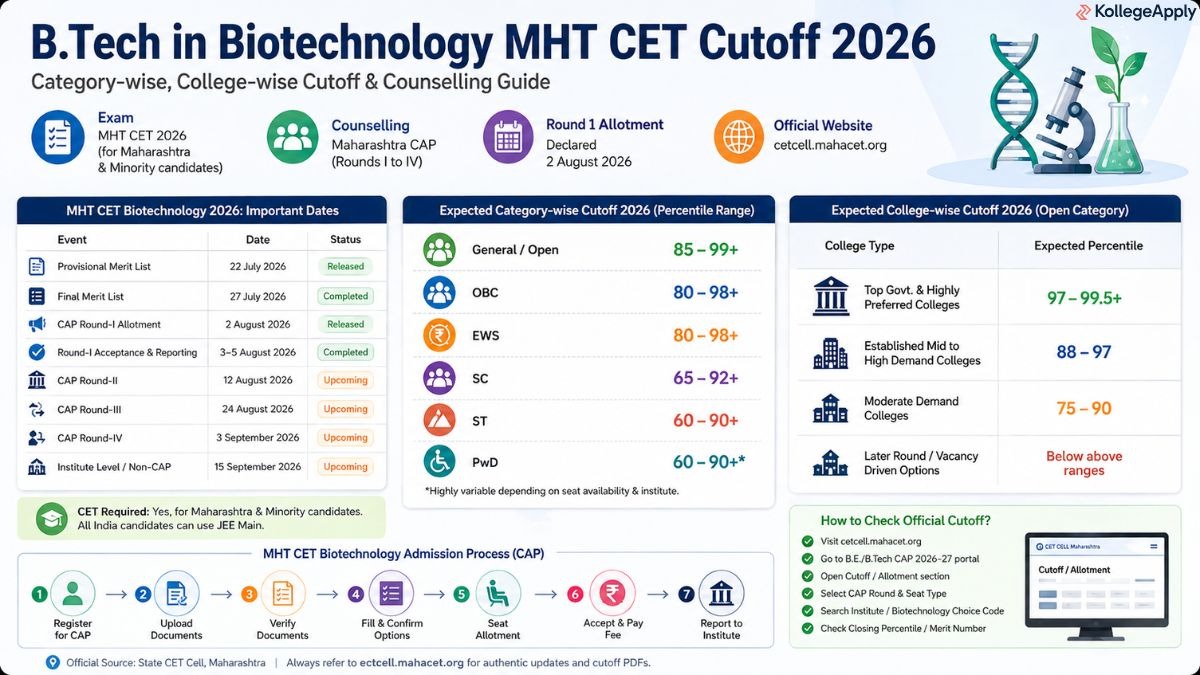
The following table provides a snapshot of the MHT CET Biotechnology admission process. Since cutoffs are released according to institute, course, category, seat type and round, candidates should not treat one percentile as a universal cutoff.
What is MHT CET Cutoff 2026?
The B.Tech in Biotechnology MHT CET Cutoff 2026 is the percentile or merit position at which a Biotechnology seat is allotted in a particular CAP round. It differs across colleges, categories, seat types and rounds. Candidates should understand the difference between eligibility and admission cutoff:
- Class 12 eligibility: The minimum marks required in the prescribed subjects to become eligible for engineering admission.
- MHT-CET percentile: The candidate's performance expressed through the percentile system.
- Opening cutoff: The merit position or percentile at which allotment begins for a particular course and seat category.
- Closing cutoff: The merit position or percentile of the last candidate allotted a seat in that course, category and round.
- CAP merit number: The merit position used during the Maharashtra admission process.
Important: Maharashtra's official cutoff PDFs may display a Maharashtra State General Merit Number along with the corresponding percentile, and the exact cutoff depends on the seat type such as GOPENH, GOBCS, LOPENH, EWS or other categories.
B.Tech Biotechnology MHT CET Cutoff 2026 for PCB
Candidates searching for the B.Tech Biotechnology MHT CET cutoff 2026 for PCB should first identify the admission route through which they are applying. The PCB route is relevant to Biotechnology under the applicable Agriculture admission framework and should not automatically be treated as identical to the B.E./B.Tech engineering CAP route.
For the engineering route, candidates must follow the prescribed subject combination and eligibility conditions. For the Agriculture CAP route, Biotechnology candidates may be required to appear for MHT CET PCB or PCM, depending on the applicable rules.
Therefore, PCB candidates should check the admission brochure and the relevant CAP framework before comparing cutoffs. The cutoff can also vary by college, category, seat type and round.
Note: Candidates should not apply a PCM marks-to-percentile table directly to a PCB MHT CET score. The admission route, examination group and applicable merit process must be considered separately.
B.Tech in Biotechnology MHT CET Cutoff: Important Dates
The MHT CET B.Tech Biotechnology Admission 2026 process is being conducted through the Maharashtra B.E./B.Tech CAP. Round 1 allotment has already been processed, and candidates should follow the official schedule for subsequent rounds.
As of August 6, 2026, Round 1 seat acceptance and institute reporting scheduled through August 5 have concluded. Candidates who did not receive their preferred Biotechnology seat should monitor the subsequent CAP rounds and updated vacancy/seat information.
Note: Dates for future rounds should be treated as tentative until published by the State CET Cell.
Is CET required for B.Tech Biotechnology?
Yes, For B.E./B.Tech Biotechnology admission through Maharashtra CAP, MHT-CET is required for eligible Maharashtra State and Minority Candidature candidates. Eligible All India candidates can use JEE Main under the applicable admission rules.
For the engineering route, candidates must also meet the prescribed Class 12 subject requirements, including Physics and Mathematics. The 2026 technical education brochure should be treated as the final authority for eligibility.
Important distinction: MHT-CET also has a separate Agriculture admission framework in which B.Tech Biotechnology candidates may be required to appear for either PCM or PCB. That Agriculture CAP route should not be confused with B.E./B.Tech Biotechnology admission through the Technical Education CAP.
Category-wise B.Tech in Biotechnology MHT CET Cutoff 2026
The MHT CET Biotechnology Cutoff 2026 differs by category because Maharashtra CAP seats are distributed across Open, OBC, EWS, SC, ST and other applicable reservation categories and seat types. The ranges below are expected planning estimates, not official 2026 cutoffs. Actual closing percentiles can vary significantly according to college, choice code, category, candidature, seat type, gender reservation, seat availability and CAP round.
General (Open) Category Average Biotechnology Cutoff Range
For Open-category candidates, Biotechnology cutoffs vary considerably by college. The 2025 CAP Round-IV data shows that the cutoff was particularly competitive at Kolhapur Institute of Technology's College of Engineering, while Sinhgad College of Engineering had a lower closing percentile for its Maharashtra seats. Hence, students should create a range of options instead of targeting only one institute.
OBC Category
OBC candidates should compare their percentile with the specific GOBC/LOBC seat type rather than treating the Open cutoff as their only benchmark. The 2025 data demonstrates why this distinction matters: at Sinhgad College of Engineering, for example, the OBC closing percentile was lower than the corresponding Open benchmark. Category certificates and other required documents must be valid during CAP verification.
EWS Category
EWS is treated separately from the social reservation categories. The 2026-27 brochure states that 10% seats are reserved for EWS candidates, subject to the applicable government rules. Because EWS cutoffs depend heavily on the number of seats and participating candidates, they can move considerably between rounds. For example, the official 2025 allotment data for KIT's Biotechnology EWS seats shows a Round-IV closing score around 88.98 percentile, while Round-I started much higher.
SC Category
SC candidates can benefit from the Maharashtra State reservation framework, but the actual Biotechnology cutoff is still college- and seat-specific. The 2025 CAP-IV data for Sinhgad College of Engineering, for instance, recorded a GSCH closing percentile of about 84.47, while Tulsiramji Gaikwad Patil College recorded a GSCS benchmark of about 80.22. These figures show why category-specific previous cutoffs are more useful than a single statewide prediction.
ST Category
ST cutoffs can fluctuate sharply because the number of seats available in a particular Biotechnology programme may be small. For example, the 2025 official cutoff for Tulsiramji Gaikwad Patil College's Biotechnology programme showed an ST-related closing percentile around 81.45, while Sinhgad's official data also shows ST seat movement at a lower percentile. Students should therefore examine the exact seat type and round rather than relying only on a general ST estimate.
PwD Category
PwD reservation is treated as a horizontal reservation within the applicable categories. The 2026-27 brochure specifies 5% seats for candidates with benchmark disability, subject to the prescribed conditions and documentation. Because the number of eligible candidates and seats can be very small, PwD cutoffs should not be predicted using the Open-category cutoff alone.
Note: These ranges are estimates built from previous Biotechnology admission trends and should be read alongside official college-wise cutoff PDFs released after each round.
B.Tech Biotechnology Government Colleges in Maharashtra: MHT CET Cutoff
Candidates looking specifically for B.Tech Biotechnology government colleges in Maharashtra and their MHT CET cutoff should compare the institute, course, category, seat type and CAP round rather than relying on a single state-level cutoff.
Government and government-aided institutes can have comparatively competitive cutoffs because of their fee structure, reputation, available seats and student preferences. However, the availability of a dedicated Biotechnology programme can vary from year to year. Candidates should always verify the current CAP seat matrix before filling their choices.
One government institute included in the expected college-wise data is Government College of Engineering, Aurangabad, for which the article's previous-year trend indicates an approximate opening percentile of 82+ and closing percentile of 62+.
Important: The availability of Biotechnology seats and the exact cutoff can change by admission year and CAP round. Candidates should check the latest official seat matrix and cutoff list before finalising their options.
Expected College-wise B.Tech Biotechnology Cutoff 2026
There is no reliable single percentile that guarantees admission to a particular Biotechnology college. The actual cutoff depends on the institute's CAP choice code, seat matrix, category, candidature type and round. Candidates should therefore compare the 2025 closing percentile/merit position of the same institute, branch, category and seat type with their 2026 percentile rather than relying on a generic college-tier estimate.
Here's an expected college-wise closing percentile pattern for B.Tech Biotechnology based on previous year trends. Candidates can consider these as a planning reference, not an official figure and always verify against the live CAP data for 2026.
Important: Not every listed institute offers a dedicated Biotechnology seat every year — always check the current CAP seat matrix before finalising your choice list, since intake and branch availability can change.
Round-wise B.Tech in Biotechnology MHT CET Cutoff
The 2026-27 admission rules provide for CAP Rounds I, II, III and IV. The first round has specific rules regarding auto-freezing, acceptance and betterment. Candidates who receive their first preference are automatically frozen, while candidates receiving another preference can choose to accept or seek betterment according to the prescribed process. CAP cutoffs do not remain fixed, they change after every round, and understanding this movement is key to strategic choice filling.
- Round 1: The first and usually the tightest round, since maximum seats are up for grabs and competition peaks. Cutoffs here are often the highest across the whole process for popular colleges.
- Round 2: Some candidates who got better options elsewhere vacate their Round 1 seats, so cutoffs can dip slightly for mid-tier colleges, though top colleges may hold steady.
- Round 3: Further seat churn happens as students confirm final choices. Biotechnology seats at less-preferred colleges often see a noticeable drop in cutoff here.
- Mop-up Round: Held for remaining vacant seats; cutoffs can fall considerably since demand has largely been absorbed in earlier rounds.
- Spot Round/ILAP: Institute-level admission for seats still vacant after CAP; this is usually first-come-first-served against the merit list rather than a strict percentile cutoff, and is a good backup for Biotechnology aspirants.
Previous Year B.Tech Biotechnology MHT CET Cutoff Trends
Analysing the MHT CET Biotechnology Cutoff from previous admission cycles helps students understand how competition has changed across colleges. However, cutoff trends can vary based on category, seat type, institute, candidate preferences and CAP round. The 2026 figures below are indicative estimates and should not be treated as official cutoffs.
Note: The 2024 and 2025 figures are indicative trend ranges compiled for comparison. Candidates should refer to the official Maharashtra State CET Cell cutoff PDFs for exact institute-, category- and round-wise closing positions.
How Much Percentage Is Required for B.Tech Biotechnology?
For B.E./B.Tech admission through the Maharashtra engineering CAP, candidates must meet the prescribed Class 12 eligibility requirements. The 2026 brochure specifies 45% marks in the prescribed subjects for general candidates, while 40% applies to eligible Maharashtra reserved-category, EWS and PwD candidates as specified in the rules. Physics and Mathematics are compulsory subjects, along with one permitted third subject.
This Class 12 percentage is an eligibility requirement, not the MHT-CET admission cutoff. A candidate must separately meet the applicable MHT-CET/JEE Main and CAP requirements.
Factors Affecting B.Tech Biotechnology MHT CET Cutoff
The cutoff is not decided by a fixed formula such as "90 percentile means Biotechnology." Instead, it emerges from the interaction between merit, seat availability and candidate preferences during CAP. This is why the same percentile can produce different outcomes for two students depending on their category, candidature and choice list.
Students should consider the following factors while interpreting the MHT CET Biotechnology Cutoff 2026. The official CAP framework itself takes account of merit, seat allocation, candidature type, reservation and option preferences during allotment.
- Number of Applicants: More candidates competing for limited Biotechnology seats can push the cutoff upward.
- Difficulty Level: Changes in exam difficulty can alter percentile distribution and merit positions.
- Number of Seats: A larger intake may create additional opportunities.
- Reservation: Category-specific seat availability affects the cutoff.
- Previous-Year Trends: Students and counsellors often use earlier cutoffs to frame their preferences.
- Candidate Preferences: If more candidates place Biotechnology higher in their preference lists, the cutoff may rise.
- Counselling Participation: Candidates who skip later rounds can create movement in the seat matrix.
- New Colleges: New or newly approved programmes can redistribute student preferences.
- Seat Matrix: The number and type of seats available in a specific CAP round can directly influence the closing cutoff.
- Home University Status: Maharashtra CAP allotment can distinguish Home University and Other Than Home University seats.
- Gender/Horizontal Reservations: Applicable seat categories can create different closing benchmarks.
B.Tech in Biotechnology MHT CET Cutoff Marks vs Rank Analysis
Students often search for MHT CET Biotechnology Rank immediately after receiving their score. However, raw marks and percentile are not interchangeable. MHT CET uses a percentile-based system, and the normalisation process means that the same raw score may not always produce the same percentile across examination sessions.
For Biotechnology candidates using the PCB route, students should not apply the PCM marks table directly to their own score. The admission brochure specifically recognises PCB MHT CET for Biotechnology eligibility. The following table is only an expected PCM reference; actual 2026 marks-to-percentile relationships vary by shift and examination group.
Important: These are not official Biotechnology admission ranks. A candidate's actual admission position depends on the relevant merit list, category, candidature and seat type.
Expected B.Tech in Biotechnology MHT CET Cutoff 2026
The MHT CET Biotechnology Expected Cutoff 2026 should be treated as an estimate rather than a guaranteed admission score. The strongest available basis is the previous year's official cutoff combined with 2026 seat availability, candidate preferences and the movement observed in Round-I.
Because the 2025 cutoffs differed substantially across Biotechnology colleges—from around 84.61 percentile at Tulsiramji Gaikwad Patil College to around 99.06 percentile at KIT—there is no sensible single expected cutoff for the entire state.
College-level Expected Range
Counselling After B.Tech in Biotechnology MHT CET Cutoff
Clearing the expected cutoff is only one part of the admission process. A candidate still needs to complete CAP registration, merit-list formalities, option selection, seat acceptance and institute reporting. The 2026-27 brochure states that candidates can fill a minimum of one and maximum of 300 options, and the order of options determines their preference priority.
The first option in the candidate's list is treated as the highest-priority preference. Therefore, students should build their list strategically instead of entering only one or two colleges. The step-by-step MHT CET B.Tech in Biotechnology Admission Process is as follows:
- Check MHT CET Result: Download the scorecard and note the relevant percentile.
- Register for CAP: Complete the engineering CAP application within the notified period.
- Upload Documents: Submit the required certificates and supporting documents.
- Complete Scrutiny/Verification: Ensure the application and category claims are verified.
- Check Final Merit List: Confirm your merit number and category details.
- Fill Option Form: Add Biotechnology colleges and branches in your preferred order.
- Confirm Options: Submit and confirm the option form before the deadline.
- Check Seat Allotment: Review the college, course and seat category allotted.
- Accept/Freeze or Seek Betterment: Follow the applicable CAP rules carefully.
- Pay Seat Acceptance Fee: Complete online payment where required.
- Report to Institute: Submit documents and complete admission formalities.
- Participate in Later Rounds: If eligible and seeking betterment, follow the next-round rules.
How to Check Official B.Tech Biotechnology MHT CET Cutoff 2026?
The official cutoff should always be checked on the Maharashtra State CET Cell engineering admission portal. Avoid relying solely on screenshots or social-media posts because CAP cutoffs are published by round and can contain different seat types such as Home University, Other Than Home University, State Level, EWS, TFWS and All India seats.
The CET Cell's official engineering portal also maintains an archive of previous CAP cutoff lists, including 2023-24, 2024-25 and 2025-26. The steps to Check the Official Cutoff are:
- Visit the State CET Cell official website.
- Open the B.E./B.Tech CAP 2026-27 admission portal.
- Look for the Cutoff/Allotment section.
- Select the applicable CAP round.
- Open the Maharashtra State or All India cutoff list as applicable.
- Search for the Biotechnology choice code or institute name.
- Check the relevant category and seat type.
- Compare the closing percentile/merit number with your own details.
- Repeat the process after each CAP round.
What are the Documents Required During Counselling after B.Tech in Biotechnology MHT CET Cutoff?
Document verification is an important part of CAP. Candidates should prepare their certificates before option filling because an incorrect category claim or missing certificate can affect eligibility for a reserved seat. The exact document list can vary according to candidature and category.
The 2026-27 admission brochure requires candidates to upload valid documents with the CAP application and provides specific documentation requirements for reserved, disability, defence, EWS and other candidature categories. The Common Documents includes:
Note: Candidates should verify the current official checklist before reporting because document requirements can change according to candidature type.
Common Mistakes Students Make during B.Tech in Biotechnology MHT CET Cutoff
Many counselling problems occur after the exam rather than during it. A candidate may have a sufficient percentile but still lose an opportunity by entering too few choices, misunderstanding category cutoffs or missing an acceptance deadline.
The 2026 CAP rules are particularly important for candidates who receive an allotment in Round-I because the choice between freezing a seat and seeking betterment can affect participation in subsequent rounds. The official portal clearly advises candidates to exercise this option carefully. Some of the Mistakes to Avoid:
- Locking only a few college choices
- Looking at Open cutoff when you qualify under another category
- Ignoring Home University/Other Than Home University distinctions
- Treating expected cutoff as an official cutoff
- Missing CAP registration deadlines
- Failing to confirm the option form
- Not checking previous-round cutoffs
- Ignoring less popular but suitable Biotechnology colleges
- Choosing a seat without understanding freeze/non-freeze rules
- Missing document verification
- Failing to pay the seat acceptance fee within the deadline
- Not reporting to the allotted institute
- Assuming Round-I is the final opportunity
- Depending on unofficial cutoff screenshots instead of the CET Cell portal
FAQs on B.Tech in Biotechnology MHT CET Cutoff
Is CET required for B.Tech Biotechnology?
Yes, MHT-CET is required for eligible Maharashtra State candidates. PCB MHT-CET is also accepted for Biotechnology under the prescribed 2026 admission rules.
Can I get Biotechnology through MHT CET?
Yes, eligible candidates can get Biotechnology through MHT CET, subject to the applicable admission route, Class 12 eligibility requirements, percentile, category, seat availability and CAP rules.
What are the government colleges for Biotechnology in Maharashtra through MHT CET?
Government College of Engineering, Aurangabad is included in the college-wise Biotechnology cutoff data covered in this article. However, candidates should verify the current CAP seat matrix because the availability of a dedicated Biotechnology programme can change from one admission year to another.
What is the cutoff for Biotechnology?
The B.Tech Biotechnology Cutoff varies by college, category, seat type and CAP round. Check the latest official MHT CET Biotechnology Cutoff for accurate closing ranks.
How much percentage is required for B.Tech Biotechnology?
Maharashtra State candidates generally need 45% in the qualifying subjects; eligible reserved, EWS and PwD candidates need 40%, subject to official eligibility rules.
What is the difference between GOBC and LOBC for Biotechnology?
GOBC and LOBC are seat-type codes that can appear in Maharashtra CAP cutoff data. Candidates should check the official CAP brochure and the relevant cutoff PDF to understand the applicable seat pool and compare the correct category-specific closing percentile.
Can I get VJTI with 93 percentile in MHT CET?
A 93 percentile does not guarantee VJTI admission. Chances depend on the branch, category, seat type and CAP round. Check the official 2026 cutoff.
Does the MHT CET Biotechnology Cutoff change every round?
Yes, The cutoff can change in each CAP round because seat availability, candidate preferences and admissions change after every allotment.
Is there a separate cutoff for reserved categories?
Yes, MHT CET Biotechnology Cutoff can vary for OBC, EWS, SC, ST and PwD candidates based on reservation and available seats.
Where can I check the official MHT CET Biotechnology Cutoff 2026?
Check the Maharashtra State CET Cell's official FE CAP portal for round-wise college, category and seat-type cutoff data.
What is a good MHT CET Biotechnology Rank?
A good Biotechnology MHT CET Rank depends on the college and category. Compare your rank with previous-year closing ranks and the latest CAP cutoff.
Can I get Biotechnology with 80 percentile in MHT CET?
Yes, some Biotechnology colleges may be possible at 80 percentile, especially in later rounds. Check college-wise cutoffs and vacant seats before choice filling.
What happens after the MHT CET B.Tech Biotechnology cutoff?
After allotment, candidates must accept the seat, pay the required fee and report to the institute. Eligible students can participate in later CAP rounds.