The MD Psychiatry syllabus is a three-year postgraduate medical curriculum that combines psychiatric theory, neuroscience, clinical assessment, psychopharmacology, psychotherapy, emergency psychiatry and specialty-based clinical training. The AIIMS Rishikesh curriculum divides academic content into six semesters, with clinical postings, research methodology, thesis work and assessments running alongside classroom and bedside learning.
The course also provides exposure to areas such as child and adolescent psychiatry, addiction medicine, geriatric psychiatry, neuropsychiatry, community psychiatry, consultation-liaison psychiatry and sleep medicine. Practical learning includes psychiatric interviews, mental-status examination, case management, ECT, rTMS, EEG and other neuropsychiatric procedures, depending on the training setup.
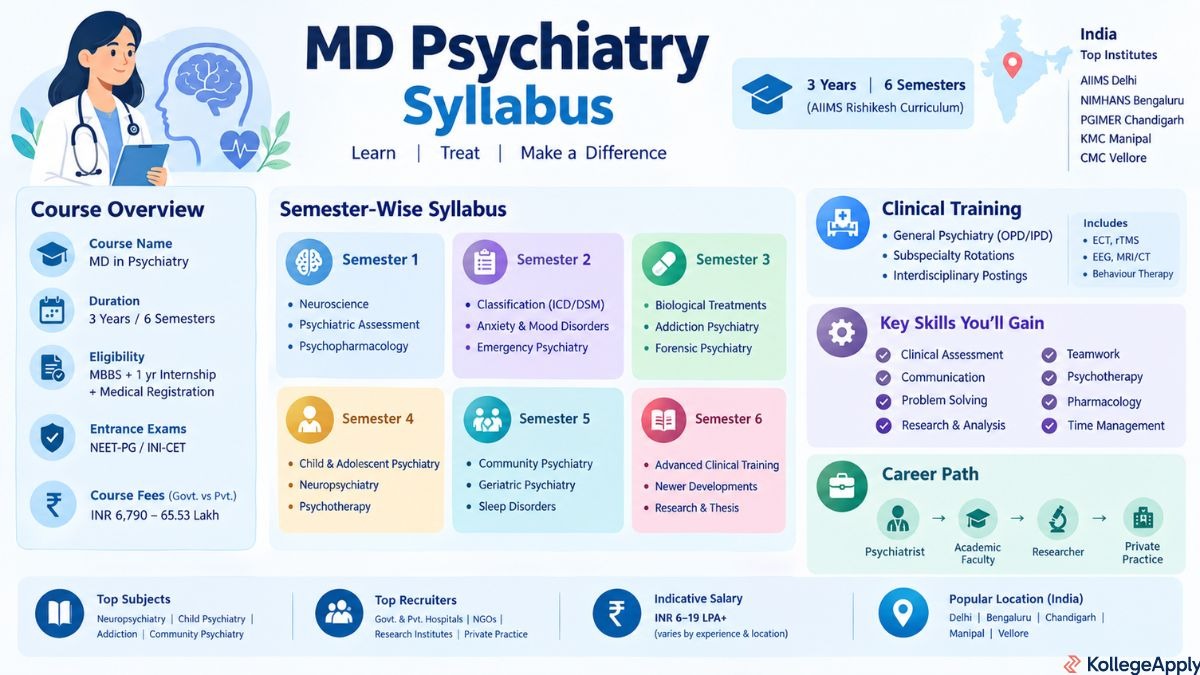
Table of Contents
- MD Psychiatry Syllabus Semester-Wise
- MD Psychiatry Syllabus in Private University
- Electives in MD Psychiatry Syllabus
- Practical Training / Internship in MD Psychiatry
- Thesis and Research in MD Psychiatry
- Skills Developed Through MD Psychiatry Syllabus
- Books for MD Psychiatry Syllabus
- MD Psychiatry Syllabus FAQs
MD Psychiatry Syllabus Semester-Wise
The MD Psychiatry syllabus at AIIMS Rishikesh is structured across three years and six semesters, combining theoretical learning, clinical training, interdisciplinary postings, research and practical skills. The curriculum covers neuroscience, psychiatric assessment, classification and management of mental disorders, psychopharmacology, psychotherapy, addiction psychiatry, child and adolescent psychiatry, neuropsychiatry, community psychiatry and other subspecialties.
Along with subject-specific teaching, students participate in seminars, journal clubs, group discussions, case conferences, clinical postings and research activities. The curriculum also includes postings in Internal Medicine, Neuroanatomy, Neurophysiology, Neurology, Neuro-radiology, Nuclear Medicine and Clinical Psychology.
MD Psychiatry Syllabus Semester-Wise
Note: The sixth-semester curriculum is designed to consolidate topics covered during the earlier semesters and incorporate newer developments in the specialty.
MD Psychiatry Syllabus in Private University
The MD Psychiatry syllabus in a private university can follow a similar postgraduate competency framework while varying in the organisation of clinical postings, elective exposure and academic activities. Sharda University’s School of Medical Sciences and Research curriculum for the 2021–24 session covers basic sciences, neuropsychiatry, psychiatric disorders, psychopharmacology, psychotherapy, child psychiatry, community psychiatry, addiction psychiatry and research methodology.
Sharda’s programme also specifies a 36-month clinical posting schedule, including 18 months in area/specialty wards and OPD, Neurology, Emergency Medicine/Internal Medicine, Consultation-Liaison Psychiatry, forensic psychiatry, Clinical Psychology, Addiction Psychiatry, Child and Adolescent Psychiatry and Community Psychiatry.
Electives in MD Psychiatry Syllabus
Elective exposure is not presented identically in the two curriculum documents. Sharda University explicitly lists a two-month elective posting according to the student’s choice within the same institute, whereas the AIIMS Rishikesh curriculum specifies structured rotations through available Psychiatry subspecialties rather than describing them as a separate elective block.
At AIIMS Rishikesh, students are posted through available subspecialties during General Psychiatry training, with each listed subspecialty having a defined three-month rotation during the relevant clinical training period.
Practical Training / Internship in MD Psychiatry
MD Psychiatry practical training is an essential part of the programme and should not be confused with the compulsory MBBS internship completed before postgraduate admission. During MD training, students work in psychiatric OPDs, inpatient wards, emergency settings and specialty services under supervision.
At AIIMS Rishikesh, postgraduate students undertake General Psychiatry OPD and IPD training, emergency postings and rotations through available subspecialties. They are also required to maintain clinical records and a log book documenting their training.
AIIMS Rishikesh specifically mentions hands-on training in behaviour therapies, modified ECT, rTMS, EEG, polysomnography and actigraphy. The curriculum also includes exposure to lumbar puncture, alcohol breath analysis, urine drug screening and interpretation of CT, MRI and PET brain imaging.
Interdepartmental Postings at AIIMS Rishikesh
The AIIMS Rishikesh MD Psychiatry curriculum specifies several mandatory interdepartmental postings. These are intended to strengthen the understanding of neurological, medical, neurophysiological and psychological conditions relevant to psychiatric practice.
The Neurology posting includes neurological history and examination, common neurological disorders, epilepsy work-up and lumbar puncture. Neuro-radiology training covers CT and MRI brain interpretation, including recognition of common findings such as stroke, hydrocephalus, oedema, atrophy, tumours and other lesions.
Thesis and Research in MD Psychiatry
Research and thesis work form an important component of the MD Psychiatry curriculum. At AIIMS Rishikesh, every MD Psychiatry student is required to undertake a thesis under a postgraduate teacher, with a co-guide where appropriate. The curriculum covers protocol preparation, literature review, hypothesis development, methodology, sample-size calculation, statistical analysis and research documentation.
Students also participate in journal clubs, seminars, research methodology teaching and thesis discussions. The AIIMS curriculum requires postgraduate students to undertake academic presentations and submit at least one research paper during postgraduate training, subject to the requirements specified in the curriculum.
Skills Developed Through MD Psychiatry Syllabus
The MD Psychiatry syllabus is designed to develop more than theoretical knowledge. Its competency framework includes psychiatric assessment, diagnostic reasoning, treatment planning, communication, research, teaching, leadership and medico-legal skills. AIIMS Rishikesh specifically identifies competencies involving patient interviewing, therapeutic alliance, diagnosis, management plans, psychosocial interventions and long-term follow-up.
Sharda University similarly identifies competencies in history taking, physical and mental-status examination, investigations, treatment planning, psychiatric emergencies, rehabilitation, communication, teamwork and ethical practice.
Books for MD Psychiatry Syllabus
The MD Psychiatry books should support both core psychiatric theory and clinical decision-making. Students generally need a combination of comprehensive textbooks, concise revision resources, psychopharmacology references, clinical guidelines and specialty-specific reading rather than relying on a single book.
MD Psychiatry Syllabus FAQs
What is covered in the MD Psychiatry syllabus?
It covers neuroscience, psychiatric disorders, psychopharmacology, psychotherapy, emergencies, child psychiatry, addiction, neuropsychiatry, community psychiatry and research.
How many semesters are there in MD Psychiatry?
MD Psychiatry is a three-year course divided into six semesters in the AIIMS Rishikesh curriculum, with theory and clinical training conducted throughout.
Does MD Psychiatry include practical training?
Yes. Training includes OPD, IPD, emergency psychiatry, specialty postings, case work-up, procedures, investigations and supervised patient management.
Are electives included in MD Psychiatry?
Sharda University lists a two-month elective posting. AIIMS Rishikesh specifies structured rotations through Psychiatry subspecialties.
Is thesis work part of the MD Psychiatry syllabus?
Yes. AIIMS Rishikesh requires an MD Psychiatry thesis covering research methodology, protocol development, analysis and academic presentation.
Which books are useful for MD Psychiatry?
Kaplan & Sadock, Fish, Lishman, Stahl and Oxford Psychiatry are among the recommended references listed in the cited curriculum.
Does MD Psychiatry include child psychiatry?
Yes. Child psychiatry covers developmental disorders, autism, ADHD, learning disorders, eating disorders and childhood mood and anxiety disorders.
Does MD Psychiatry include addiction psychiatry?
Yes. The syllabus covers alcohol, opioids, cannabis, stimulants, nicotine and other substance-related and behavioural addictions.
What skills are developed through the MD Psychiatry syllabus?
Students develop psychiatric assessment, diagnosis, treatment planning, counselling, emergency care, research, communication and multidisciplinary teamwork skills.
What is the career scope after MD Psychiatry?
Graduates can work in hospitals, mental-health centres, medical colleges, research, rehabilitation, addiction services, community programmes and private practice.