M.Tech in Food Technology is a two-year program offered to students at the postgraduate level. M.Tech in Food Technology focuses on imparting knowledge about the nutritional value, biochemical properties, and chemical composition of various food items. The program covers several industry-relevant topics such as advances in food chemistry and nutrition, food processing, food quality systems and management, computer applications in the food industry, and many more.
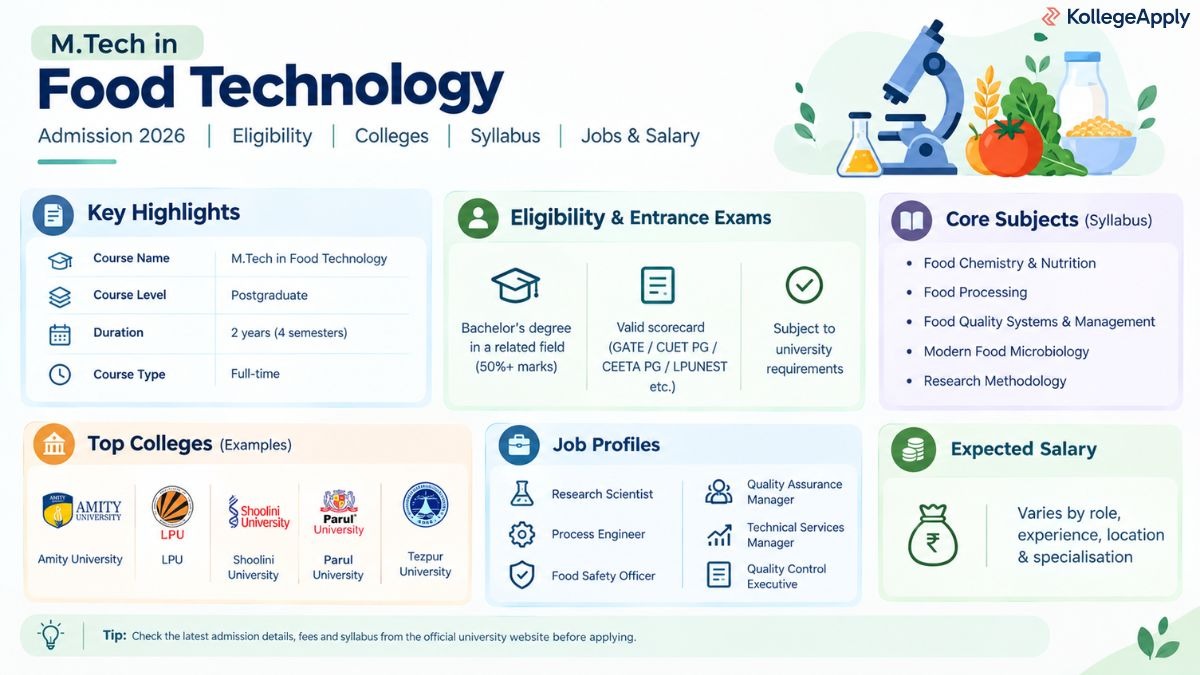
Students aiming for admission to M.Tech in Food Technology colleges must adhere to the required eligibility criteria. M.Tech in Food Technology eligibility includes holding a bachelor’s degree in Food Science, Food Engineering, Dairy Technology, or a related field. Attaining a minimum score of 55% marks is also important for admission. Showcasing a valid entrance exam scorecard such as GATE, LPUNEST, CUET PG, etc., is crucial for M.Tech in Food Technology admission.
After completing M.Tech in Food Technology, graduates can work in food processing, FMCG, dairy, nutraceuticals, food safety, quality assurance, research and product development. Common roles include Food Technologist, Food Scientist, Quality Assurance Manager, Food Safety Specialist, Process Engineer and R&D professional. Salary varies significantly by role, employer, experience, location and technical specialisation.
Table of Contents
- M.Tech in Food Technology Key Highlights
- What is M.Tech in Food Technology?
- Why Study M.Tech in Food Technology?
- Is M.Tech in Food Technology Worth It in 2026?
- M.Tech in Food Technology Eligibility Criteria
- M.Tech in Food Technology Entrance Exams 2026
- M.Tech in Food Technology Colleges
- M.Tech in Food Technology Admission Process 2026
- M.Tech in Food Technology Syllabus
- What Skills are Required for M.Tech in Food Technology?
- M.Tech in Food Technology Jobs & Salary
- M.Tech in Food Technology Vs MTech Electrical Engineering
- M.Tech in Food Technology FAQs
M.Tech in Food Technology Key Highlights
M.Tech in Food Technology generally follows a two-year, four-semester structure combining advanced classroom learning, laboratory work, research and project-based training. The exact subjects, entrance route, eligibility and fees vary across universities. The table below provides a consolidated overview for students comparing M.Tech Food Technology colleges in India.
What is M.Tech in Food Technology?
M.Tech in Food Technology is a postgraduate programme offered to students for a duration of two years. This advanced PG programme focuses on the knowledge required in the manufacturing, processing, preservation, packaging, labeling, and distribution of food products. M.Tech in Food Technology subjects cover topics such as the chemical and physical composition of food, nutritional value, and industrial food processing methods.
M.Tech in Food Technology colleges focus on core subjects such as Advances in Food Processing, Transfer Processes in Food Processing, Food Regulations and Food Safety Management, and Toxicology of Food and Nutraceuticals. M.Tech in Food Technology prepares graduates to keep up with emerging trends like functional foods, sustainable processing, and food safety management.
Why Study M.Tech in Food Technology?
Students choosing M.Tech Food Technology can benefit from advanced technical education and exposure to an industry that covers food manufacturing, processing, quality and safety.
- Growing food-processing sector: The programme prepares graduates for roles across food manufacturing, processing, packaging and quality management.
- Specialised technical skills: Students develop expertise in food processing, food analysis, safety, quality systems and product development.
- Research opportunities: M.Tech programmes generally include research projects, dissertations or industry-oriented studies.
- Career flexibility: Graduates can work in production, quality assurance, R&D, food safety, product development and regulatory functions.
- Scope for leadership: With experience, professionals can move into quality, production, technical and food safety management roles.
- Entrepreneurship opportunities: Technical knowledge can support ventures in food processing, product development, food testing and value-added food products.
Is M.Tech in Food Technology Worth It in 2026?
M.Tech in Food Technology can be a worthwhile postgraduate option for students who want to build a specialised career in food processing, food safety, quality assurance, food engineering or research. The course is particularly relevant as the food sector increasingly focuses on product quality, food safety, shelf life, automation, sustainable processing and regulatory compliance.
The value of the degree depends considerably on the institution, specialisation, laboratory exposure, research work and industry connections. Programmes at specialised food-technology institutions can provide exposure to food processing and research facilities. NIFTEM-K and NIFTEM-T, for example, offer specialised postgraduate programmes in food technology and related areas.
Salary and placement outcomes are not uniform across M.Tech Food Technology colleges. Students targeting higher-paying roles should develop technical expertise in areas such as food safety and quality systems, process engineering, product development, food analytics, automation or nutraceuticals, alongside practical industry experience.
M.Tech in Food Technology Eligibility Criteria
The eligibility requirements for M.Tech in Food Technology differ from one institution to another. Candidates should check the programme-specific eligibility before applying because accepted undergraduate disciplines and minimum marks are not identical across universities.
- Candidates generally need a four-year bachelor's degree such as B.Tech/B.E. in Food Technology, Food Engineering, Food Science and Technology or a related discipline.
- Some institutions also accept relevant M.Sc. degrees in Food Technology, Food Science, Biotechnology or allied disciplines.
- Minimum marks generally range at least 50%, depending on the university.
- Reserved-category relaxation may be available according to institutional or government rules.
- Candidates may need a valid GATE score or university-level entrance examination score, depending on the admission route.
- Some universities conduct an interview or additional selection round.
- There is generally no universal upper age limit for M.Tech admission, but applicants should verify the rules of the institution concerned.
For example, NIFTEM-K's 2026–27 prospectus specifies 60% aggregate for relevant bachelor's/master's qualifications and allows a 5% relaxation for reserved categories.
M.Tech in Food Technology Entrance Exams 2026
Colleges offer admission to students for M.Tech in Food Technology after clearing competitive entrance exams such as the GATE. Students can also secure admission to M.Tech in Food Technology without GATE, as several alternative options are available. To learn more about the entrance exams required for M.Tech in Food Technology, refer to the table below:
Note: Exam dates and fees should always be rechecked on the respective official examination or university website before applying.
M.Tech in Food Technology Colleges
India has several M.Tech in Food Technology colleges that admit students based on GATE scores and other state or university level exams. Students will be required to meet the M.Tech in Food Technology eligibility for confirming their seats. Check out the table given below to learn more:
M.Tech in Food Technology Admission Process 2026
M.Tech in Food Technology admission to any desired college requires a structured process to be followed. Students aiming for the M.Tech in Food Technology program need to ensure that they have met the eligibility requirements for the admission process. The step-by-step procedure consists of factors such as registration, appearing for the entrance exam, merit list declaration, and documentation, along with the payment of course fees. Check out the step-by-step procedure of the MGM University admission process for better understanding:
- Step 1: Initially, students must register on the official MGM University admission portal, i.e., admissions.mgmu.ac.in.
- Step 2: Upload the required documents and complete the registration form carefully. After filling in all the details, pay the application fee through the online payment system.
- Step 3: Students will receive an entrance test link for MGMU CET.
- Step 4: Students are required to appear for the entrance test on the scheduled date and qualify for the further admission process.
- Step 5: After receiving the entrance exam score, selected students will be invited for the final stage of admission.
- Step 6: Selected students must complete document verification and pay the admission fees to confirm their seat.
Required Documents
M.Tech in Food Technology Syllabus
M.Tech in Food Technology subjects offer students a wide range of knowledge necessary for building a strong career. The syllabus consists of both theory and practical components, helping students gain advanced knowledge and hands-on experience. The table below provides a reference to the M.Tech in Food Technology syllabus at Lovely Professional University:
Electives
What Skills are Required for M.Tech in Food Technology?
M.Tech Food Technology graduates need a combination of scientific, technical, analytical and managerial skills. The most important skills include:
- Food processing knowledge: Understanding processing, preservation and production techniques.
- Food safety knowledge: Ability to understand hazards, safety systems and regulatory requirements.
- Quality management: Knowledge of food testing, quality assurance and quality-control systems.
- Analytical thinking: Ability to interpret laboratory results and identify quality or processing problems.
- Research skills: Designing experiments, analysing results and preparing technical reports.
- Problem-solving: Finding practical solutions to processing, quality and product-development challenges.
- Technical skills: Familiarity with food-analysis equipment, processing machinery and laboratory methods.
- Communication: Ability to explain technical findings to production, quality and management teams.
- Team management: Working effectively with multidisciplinary food-processing and R&D teams.
- Strategic thinking: Understanding production efficiency, sustainability, product development and market requirements.
M.Tech in Food Technology Jobs & Salary
M.Tech Food Technology graduates can work in food manufacturing, FMCG, dairy, nutraceuticals, quality testing, research and food safety. The actual salary depends on experience, job location, employer, specialisation and technical skills.
Note: These are indicative market ranges, not guaranteed salaries or official pay scales. Actual compensation can vary substantially by employer, location, role, skills and experience.
M.Tech in Food Technology Vs MTech Electrical Engineering
Students must focus on gathering information about all available options before taking admission to M.Tech in Food Technology colleges. MTech in Electrical Engineering is also a highly sought-after programme among students. The comparison below will help in understanding which programme better aligns with students’ career goals:
M.Tech in Food Technology FAQs
What is M.Tech in Food Technology?
M.Tech in Food Technology is a 2-year PG programme covering food processing, safety, quality, packaging, engineering and product development.
What is M.Tech Food Technology eligibility?
Eligibility varies by college. Generally, candidates need a relevant B.Tech/B.E. or M.Sc. with the required minimum marks.
Can I do M.Tech Food Technology after B.Tech Biotechnology?
Yes, some universities accept Biotechnology graduates. Eligibility is institution-specific, so check the selected college before applying.
Can I pursue M.Tech Food Technology without GATE?
Yes. Some colleges offer admission through university entrance tests or their own selection process without requiring GATE.
What is the M.Tech Food Technology duration?
M.Tech Food Technology is generally a two-year postgraduate programme divided into four semesters.
What subjects are taught in M.Tech Food Technology?
Subjects include food processing, food engineering, food chemistry, microbiology, food safety, packaging, quality management and research.
What is the salary after M.Tech Food Technology?
Salary varies by role and experience. Graduates can start around INR 4–8 LPA, with higher packages possible with experience.
What are the career options after M.Tech Food Technology?
Graduates can work as Food Technologists, Food Scientists, QA professionals, Food Safety Specialists, Process Engineers and R&D professionals.
Is M.Tech in Food Technology a good course?
It can be a good option for students interested in food processing, safety, quality, product development, research and the FMCG sector.
What is the highest paid job in Food Technology?
Senior roles in food technology, R&D, quality, food safety and production management can offer higher salaries with experience and specialisation.