M.Tech in Food Technology colleges in India offer postgraduate programmes focused on advanced food processing, food engineering, preservation, packaging, food safety, quality assurance and product development. The standard M.Tech duration is two years, although the exact programme title and specialisation vary by institute.
Depending on the institute, candidates may be considered through GATE, CUET-PG, university-level entrance examinations, state-level examinations or institute-specific selection procedures. Anna University, for example, states that its M.Tech Food Technology candidates are selected through GATE and TANCET, while NIFTEM-K's 2026 admission cycle includes GATE, CUET and its own entrance route.
The eligibility requirement also differs considerably. Several institutes accept a four-year B.Tech/BE in Food Technology or allied engineering disciplines, while some universities also accept relevant M.Sc degrees. Therefore, students should compare the exact qualifying degree, entrance requirement, programme title and current fee before applying rather than assuming that every M.Tech Food Technology college follows the same criteria.
- M.Tech in Food Technology Government and Private Colleges in India
- What is the Eligibility Criteria for M.Tech in Food Technology Colleges?
- M.Tech in Food Technology Admission Process
- M.Tech in Food Technology Fees in India
- Best M.Tech in Food Technology Colleges in Tamil Nadu
- Can I Do M.Tech in Food Technology After B.Tech or M.Sc?
- FAQs on M.Tech in Food Technology
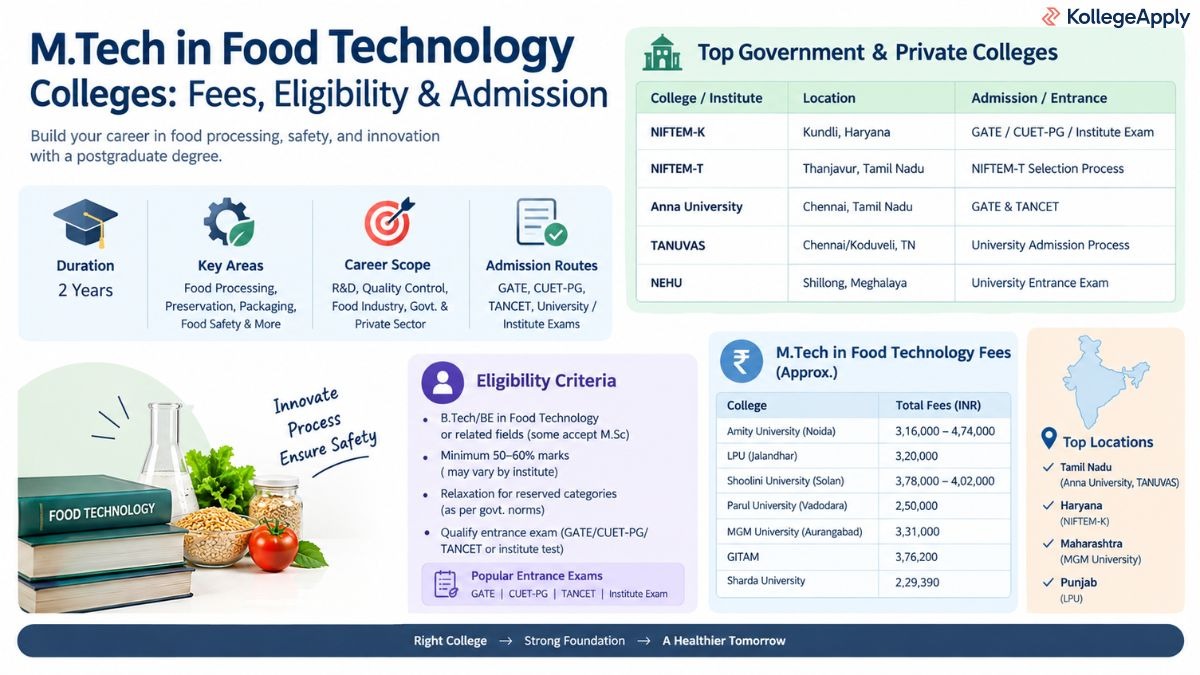
M.Tech in Food Technology Government and Private Colleges in India
The list below focuses on institutes whose official websites currently identify an M.Tech programme in Food Technology or a closely titled food-technology specialisation. Students should instead compare programme specialisation, laboratory exposure, research opportunities, admission route, fees and location.
NIFTEM-K is particularly relevant for students looking for a specialised postgraduate education in the food sector because its M.Tech portfolio extends beyond a general Food Technology label into food safety, processing engineering, plant operations and supply chain management. NIFTEM-T is another specialised institute, while Anna University and TANUVAS are important options for students specifically searching for M.Tech Food Technology in Tamil Nadu.
Government / Public Institutes
Private Universities and Institutes
The private-college options differ significantly in academic orientation. Amity's programme includes subjects such as Advanced Food Engineering, Advanced Dairy Technology, fruit and vegetable processing and food standards, while GITAM's Food Processing Technology programme emphasises engineering properties of food materials, process equipment design and food process engineering. Thus, students should not select a college only on the basis of its M.Tech title; the curriculum matters as well.
What is the Eligibility Criteria for M.Tech in Food Technology Colleges?
Eligibility for M.Tech in Food Technology colleges is not identical across India. Most programmes expect candidates to have a relevant four-year engineering or technology degree, but some institutes also accept M.Sc graduates from specified food science, biotechnology, agriculture or related disciplines. Minimum marks commonly range from 50% to 60%, depending on the institute and category.
For example, Parul University requires a B.E./B.Tech in Food Technology, Food Processing Technology, Food Technology and Management or related fields with at least 50% for the general category, whereas Amity's 2026 prospectus specifies 60% for the relevant bachelor's or master's degree. Sharda University also lists B.Tech and M.Sc pathways with a 60% requirement for its national applicants.
General Eligibility Requirements
Candidates should generally meet the following requirements:
- Hold a four-year B.E./B.Tech degree in Food Technology, Food Engineering, Food Processing or a related discipline.
- Some colleges accept relevant M.Sc degrees, particularly in Food Science, Food Technology, Biotechnology or allied subjects.
- Meet the institute's minimum percentage requirement, generally 50% to 60%, depending on the college.
- Meet any additional subject or qualification requirements specified by the institute.
- Candidates seeking admission through GATE, CUET-PG or another examination must meet the respective examination's eligibility conditions.
- Reserved-category relaxation may be available according to the institute's admission rules.
Importantly, M.Sc graduates should not assume that every M.Tech Food Technology college accepts them. For example, Sharda University explicitly lists several M.Sc backgrounds as eligible, while Amity's 2026 prospectus also permits specified master's degrees. Parul University, by contrast, primarily specifies B.E./B.Tech backgrounds for its M.Tech Food Technology programme.
Entrance Exams Accepted by M.Tech Food Technology Colleges
Admission routes vary by institute rather than following a single national counselling system. Some institutes accept GATE, some conduct their own examination, and some use more than one route. NIFTEM-K's 2026 admission notices show separate counselling routes for candidates with valid GATE and CUET scores as well as an institute entrance examination for non-GATE/non-CUET candidates.
Anna University's official Centre for Food Technology page specifically states that its M.Tech Food Technology programme is a two-year interdisciplinary course and that candidates are selected through GATE and TANCET.
M.Tech in Food Technology Admission Process
The admission process depends on the college and entrance route. Candidates should first verify whether their undergraduate degree is accepted for the particular specialisation, followed by checking the relevant entrance examination and application schedule.
For example, Amity's 2026 M.Tech Food Technology programme lists a personal interview as the selection process, whereas NIFTEM-K's 2026 admission cycle includes separate merit/counselling routes based on GATE, CUET and its own entrance examination. In most cases, the process involves:
- Check the programme-specific eligibility criteria.
- Appear for the required entrance examination, if applicable.
- Register on the university's admission portal.
- Submit academic and entrance-exam details.
- Participate in counselling, merit selection or an interview, depending on the institute.
- Complete document verification.
- Pay the admission fee and confirm the seat.
M.Tech in Food Technology Fees in India
The M.Tech in Food Technology fees vary substantially between government institutes and private universities. The difference is particularly noticeable when tuition is compared with the total amount payable after hostel, examination, laboratory, development and other institutional charges.
The following figures are taken from official university/institute sources available for the relevant admission years. They should be treated as published fee figures rather than a universal two-year cost because some institutions revise fees annually or list tuition separately from other charges. For example, NIFTEM-K's 2026 prospectus gives a first-semester total that includes multiple institutional and hostel-related components, while Amity publishes its semester tuition separately.
Note: The figures above are not directly comparable in every case. Some colleges publish only tuition, while others combine tuition with examination, laboratory, hostel, security deposit or other charges.
Best M.Tech in Food Technology Colleges in Tamil Nadu
Tamil Nadu is a particularly relevant state for students searching for M.Tech Food Technology colleges because it has specialised institutions offering postgraduate programmes in food processing, food technology and food safety. Anna University, NIFTEM-T and TANUVAS are among the most relevant institutions to investigate.
Anna University offers a dedicated M.Tech Food Technology programme through its Centre for Food Technology in Chennai. The programme is two years long, with three semesters of coursework followed by final-semester project work, and the university states that selection is through GATE and TANCET.
NIFTEM-T in Thanjavur offers three distinct M.Tech Food Technology tracks: Food Process Engineering, Food Process Technology, and Food Safety & Quality Assurance. The institute states that these programmes are two years/four semesters in duration.
TANUVAS also offers a two-year M.Tech Food Technology programme. Its official academic information lists eligibility for candidates with a four-year degree in areas such as Food Processing Technology, Food Technology, Food Process Engineering, Food Science & Nutrition, Dairy Technology or Biotechnology.
Can I Do M.Tech in Food Technology After B.Tech or M.Sc?
Yes, but the answer depends on the eligibility rules of the particular college. Candidates with a B.Tech/BE in Food Technology, Food Engineering, Food Processing Technology or related engineering disciplines are eligible for many M.Tech Food Technology programmes.
Some institutions also accept candidates with relevant M.Sc qualifications. Sharda University, for example, lists M.Sc degrees in Food Science Technology, Food Technology, Biotechnology, Agriculture and several allied life-science areas among its eligible qualifications. Amity's 2026 prospectus similarly accepts specified master's degrees in Food Science, Food Technology, Biotechnology and related disciplines.
However, eligibility should be checked programme by programme. A candidate with an M.Sc in a general science subject should not assume eligibility for every M.Tech Food Technology college.
FAQs on M.Tech in Food Technology
Can I do M.Tech in Food Technology after B.Tech?
Yes, Most M.Tech Food Technology colleges accept B.Tech/BE graduates in Food Technology, Food Processing, Food Engineering or related disciplines.
Can I do M.Tech Food Technology after M.Sc?
Yes, but only at colleges that accept relevant M.Sc degrees. Sharda and Amity list specified M.Sc backgrounds among their eligible qualifications.
Which college is best for M.Tech Food Technology in India?
NIFTEM-K, NIFTEM-T and Anna University are strong options to compare for specialised M.Tech Food Technology programmes.
What are the best M.Tech Food Technology colleges in Tamil Nadu?
Anna University, NIFTEM-T and TANUVAS are key options, with programmes covering Food Technology, processing, engineering and food safety.
Which entrance exam is required for M.Tech Food Technology?
GATE is accepted by several M.Tech Food Technology colleges. Other routes include TANCET, CUET-PG and institute-level entrance exams.
What are the M.Tech Food Technology fees in India?
Fees vary by institute. Private M.Tech Food Technology colleges may charge over INR 2 lakh, while specialised public institutes can have lower tuition.
Which M.Tech Food Technology colleges accept M.Sc graduates?
Colleges such as Sharda University and Amity list relevant M.Sc qualifications, but eligibility varies by programme and specialisation.
Is M.Tech Food Technology better than M.Sc Food Technology?
M.Tech suits students seeking stronger engineering and processing exposure, while M.Sc is generally more science-oriented. The better option depends on your background and career goal.
Is M.Sc Food Technology a good career option?
Yes, M.Sc Food Technology can lead to roles in food safety, quality control, R&D, product development and laboratory-based food industries.
Which M.Tech Food Technology specialisation should I choose?
Choose Food Process Engineering for technical processing roles, Food Process Technology for manufacturing, or Food Safety & Quality for QA and regulatory careers.